
Abortion in the Church
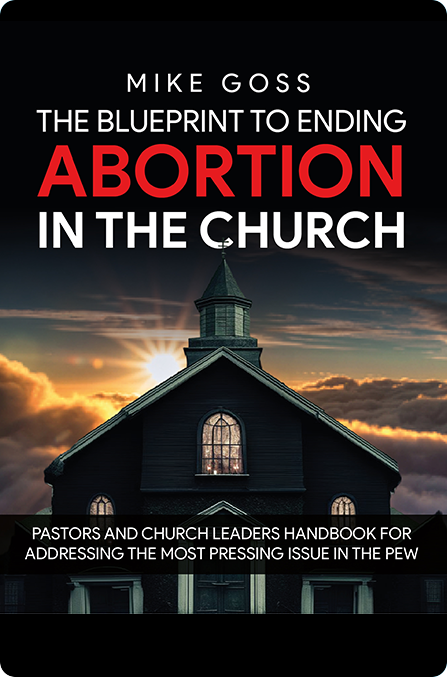
Abortion in the church? Research reveals it is. Fifty-four of women who have had an abortion identify as Catholic or Protestant. Forty percent attended church regularly at the time of their first abortion. Seventy-six percent felt that their church didn’t have a ministry they could turn to. There is a significant and troubling issue in the church.
Read More about the book...
Abortion is the most divisive issue of our time, presenting profound ethical, moral, and societal implications that demand pastoral leadership. Until now, there hasn’t been a resource to assist pastors in addressing an issue that has touched virtually every pew in some way. This groundbreaking resource enables pastors and church leaders to navigate its unique challenges and confidently engage their congregations with the biblical integrity and practical insights they have longed for. Our decades-long silence has given our Adversary free rein to evangelize virtually the entire Body of Christ with false doctrine.
This is not merely a theological exercise. Rather, it is a deep dive into its multifaceted dimensions with uncommon insights to understand the gravitational effects abortion has on women, men, families, and the church. Although it’s viewed as a deeply divisive and sensitive issue, it doesn’t have to be. Here, I sidestep the volatile debate of pro-life versus pro-choice and shift the focus to building a consensus around the one thing we all should be able to agree on: the fewer lives lost to abortion and the resulting psychological effect on women and men thereafter, the better.
This ‘Blueprint’ is modeled after the one God the Father used to address the world’s most well-known unplanned pregnancy (from a human perspective) to keep it from becoming a crisis pregnancy: the birth of Christ. He’s left us the blueprint, and it’s not the one being promoted by abortion rights advocates.
As God-honoring as our Pro-Life mission has been, we’ve been unable to move the needle in breaking the intergenerational cycle of unplanned pregnancies that leads to the risk of abortion. In John 10:10, we see Christ making it clear he’s not just pro-life but pro-abundant life. It means we are to enlarge our mission and become Pro Abundant Life. We’re still saving for heartbeats, but now it’s heaven-bound heartbeats. This pro-abundant life approach that I introduce shows how we could have prevented the needless deaths of millions of infants and the psychological scarring of millions more that came with it. The good news is we still can.
The overturning of Roe has shoved this Issue out of the closet never to return. In today’s social climate this book should be a part of every pastor and church leader’s library.

Mike Goss is a minister, author, businessman, and unapologetically pro-life. With a mind for business and a heart for Christ, he recently founded istandwiththeforgottenwomen.org. He’s confident he’s found a better way to address unplanned pregnancies that empower women to choose life for their babies and abundant life for their families, and it begins with the church.
Our Betterselves
In every situation, we are confronted with a pivotal decision where we can choose to respond in a manner that reflects our better selves or succumb to the impulses of our lower selves. That decision influences not only the present moment but plays a significant role in shaping who we become.
Dear Friend,
Regardless of one’s viewpoint, the occurrence of 70 million abortions, with an estimated 40 million due to perceived insurmountable obstacles and millions left struggling in silence with the emotional consequences, cannot be seen as an embodiment of our better selves.
This story, just one of many, hopefully will capture the essence of this moral dilemma.
Janet, not her real name, was a young woman with dreams as vast as the sky. She was driven, compassionate, and full of life, with aspirations of making a difference in the world.
But life, as it often does, threw her an unexpected curveball.
At 22, she found herself facing an unplanned pregnancy.
Overwhelmed and afraid, she felt her entire future was slipping out of her grasp.
The pressure from her boyfriend, who was not ready for the responsibilities of fatherhood, and the anxiety of disappointing her parents weighed heavily on her.
Everywhere she turned, it seemed as though the world was telling her there was only one option: abortion.
She found herself isolated the following weeks, drowning in a sea of conflicting emotions. She loved the child growing inside her, but the fear of the unknown, of the life-altering changes that motherhood would bring, was overpowering.
She had always believed in doing the right thing, but now, she wasn’t sure what the right thing was.
Finally, after days of sleepless nights and tearful prayers, Janet made her decision. She walked into the clinic, heart heavy with sorrow. The procedure was quick, but the emotional aftermath was anything but.
The weight of her choice settled deep within her soul, a burden she would carry for years to come—and shame likely forever.
The world around her moved on, but she couldn’t.
She thought that abortion would bring her relief, an escape from an impossible situation, but instead, it brought profound emptiness, a void that nothing could fill.
She couldn’t shake the feeling that she had lost a part of herself in that fleeting moment of fear—a part that represented her better self.
If only someone would have explained to her that fear is temporary, but regret is permanent.
Janet’s story is by no means unique. It echoes the experiences of millions of women who, like her, felt cornered as though there was no other way. While it seemed to solve the problem, it left them with another.
The truth is, while abortion may eliminate the immediate crisis, it does not address the root causes—the fears, the lack of support, the societal pressures—that led to that moment of desperation.
In Janet’s case, and the cases of so many others, the decision to abort was not made from a place of empowerment but from a place of fear.
It was a decision born out of helplessness, not hope—weakness, not strength.
While it provided a temporary solution, she knew it did not represent her better self—it was a response to the combination of the whispering voice in her ear and the chorus in the public square that convinced her the best solution was to end the life she was carrying rather than allow it to interrupt hers.
But what if… there had been another voice?
What if…
Janet heard a voice offering compassionate help and hope she needed for making a decision that aligned with her core values?
What if…
Instead of feeling cornered, she had felt empowered to give her baby a shot at life, to embrace the challenges ahead, and to realize it was not the end of her world.
Instead, it was a temporary problem that didn’t demand a permanent solution.
At some point, we must decide…
…whether to continue yielding to our lesser selves,
which does bring temporary relief but erodes the dignity and value we place on our lives—bringing into question our ability to empathize with those whose consciences dictate a different choice.
Or chart a new way forward that inspires us to ‘our better selves’—representing who we truly are.
If you agree the time has come, then stand with us.
Regardless, the one area we all should be able to agree on is the fewer abortions, the better.
Not just for the sake of the unborn but for the sake of the women who carry them, for the sake of the fathers who conceived them, and for the sake of our own humanity.
Our better selves are demanding it.
Become a 10k member. We need 10,000 compassionate souls like yourself willing to set aside just $10.00 a month—or any amount. Your donation will help us prove to the Janets of tomorrow that not everyone has forgotten.

Mike Goss
Founder and President
Leave email if you wish to be notified of book release. Get it as a gift for your favorite pastor

© Copyright 2024 | iStandwiththeforgottenwomen
Designed by Perfect e Solutions